

The Four Money Scripts - Which One Is Running Your Financial Life?
A quiz to find your money script - the unconscious belief about money you inherited in childhood that's been shaping every financial decision you make ever since.

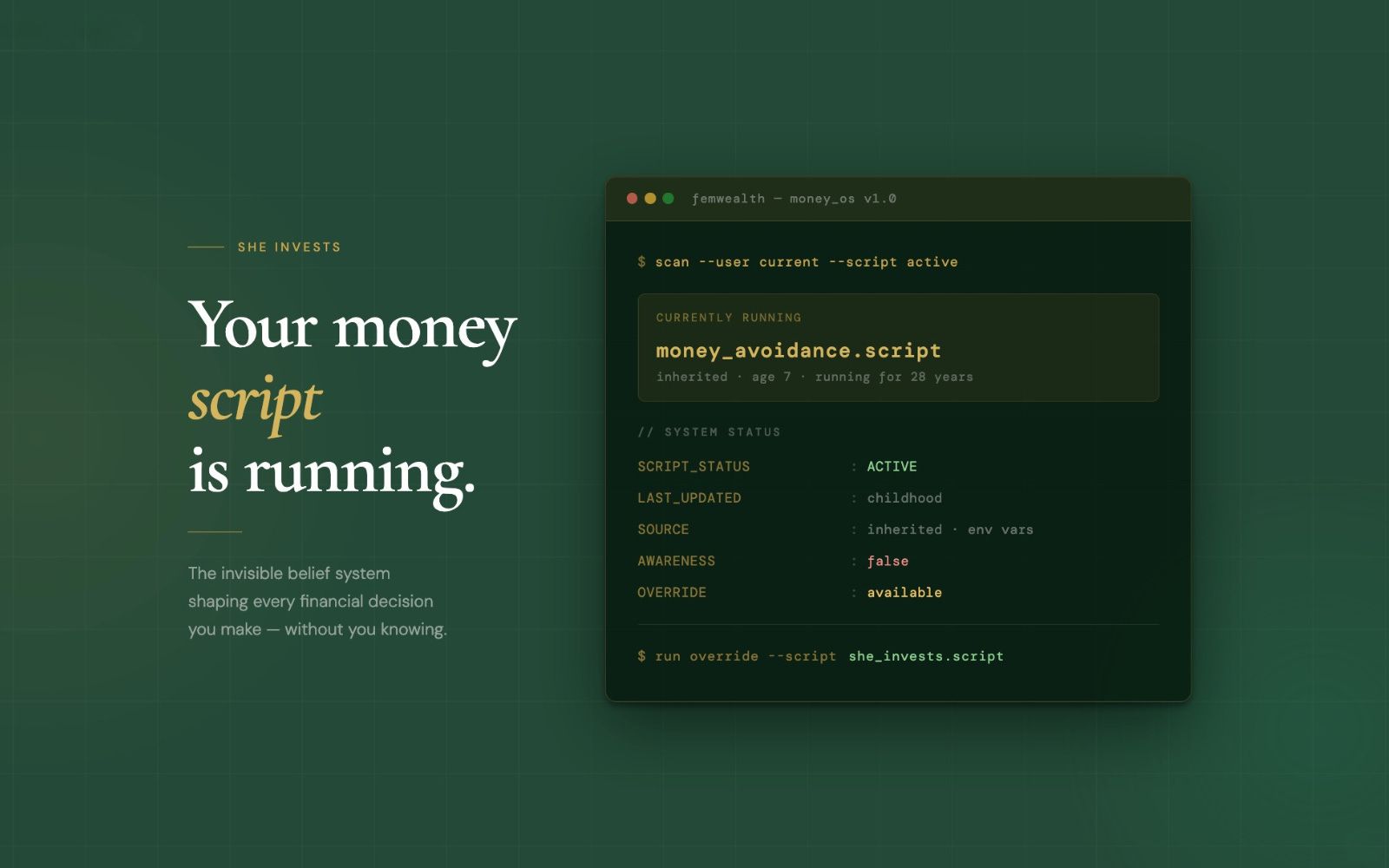
Most women don’t make financial decisions.
They react to them.
Not because they're undisciplined or uninformed. But because somewhere between childhood and now, they absorbed a set of beliefs about money so deeply that those beliefs became automatic. Invisible. The operating system running quietly in the background of every financial choice they make.
Psychologists call them money scripts.
And the research is clear: most people have no idea which one is running them.
Today we find out which one is running you.
The Quiz - Find Your Money Script
Four questions. Each one maps to one of the four money scripts identified by financial psychologist Dr Brad Klontz. Read each one and notice which lands closest to true - not the answer you think you should give, the one that actually fits.
Question 1
When you think about having significantly more money than you do now - a lot more, enough to change your life - what is your first instinctive reaction?
A. Discomfort. Wealth feels like it belongs to a certain kind of person - and you’re not sure you’re that person. Rich people are lucky, or ruthless, or both. More money would probably just create more problems.
B. Relief. Finally. Money is the thing standing between you and the life you want. If you just had more of it, everything - the stress, the relationships, the anxiety - would sort itself out.
C. Pressure. More money means more expectations. From other people, from yourself. You’d need to look the part, live the part, be the part. The idea is exciting and exhausting in equal measure.
D. Anxiety. You’d need to protect it. Invest it carefully. Make sure it didn’t disappear. More money means more to lose - and loss is the thing you think about most.
Question 2
A friend mentions casually that she’s just paid off her mortgage. How do you feel?
A. Slightly uncomfortable - like the conversation has moved into territory that doesn’t involve you. Money talk feels private, or even a little shameful. You change the subject.
B. Genuinely happy for her - and immediately think about what you’d do if you were in her position. You spend the next ten minutes mentally allocating the freed-up cash.
C. A quiet, involuntary comparison. You find yourself calculating where you are relative to her - and feeling something about the gap, whatever it is.
D. Impressed, but also wondering how she did it. You’d want to know the details - the rate, the over-payments, the strategy. You file it away.
Question 3
You receive an unexpected $2,000. What happens next?
A. It sits in your current account for months. Doing something with it feels complicated, and you’re not sure you deserve to spend it on yourself. Eventually it gets absorbed into everyday spending.
B. You have three ideas for it before the day is out. The problem isn’t deciding what to do. It’s that there are too many things you want it to fix.
C. You think about what it signals. Could you put it toward something visible - something that reflects where you want to be? Or do you wonder what other people would think if they knew you had it?
D. You know exactly where it should go. Emergency fund, pension, ISA - in that order. Spending it on anything else would feel irresponsible. You’d feel vaguely guilty if you did.
Question 4
How do you feel when someone asks you directly how much you earn?
A. Deeply uncomfortable. Money feels like a private, slightly shameful subject. You deflect or give a vague answer.
B. Fine. But you immediately want to contextualise it. You want them to know what you do with it, what you’re working toward, what it means.
C. Self-conscious. Your salary feels like a statement about your value. You’re aware of how the number lands - whether it’s impressive or not impressive enough.
D. Guarded. Not because you’re ashamed, but because you don’t think it’s anyone’s business. Financial information feels like something to protect.
Mostly A - Money Avoidance
Mostly B - Money Worship
Mostly C - Money Status
Mostly D - Money Vigilance
Most people are a blend - but one pattern tends to dominate. Keep yours in mind as you read.
Enjoying She Invests? Every Thursday I break down one investing concept, one framework, one action - written specifically for women building wealth on their own terms. Free to read, free to subscribe.
The Four Scripts - What They Are, Where They Come From, What They Cost
Money Avoidance - “Money is bad and I don’t deserve it”
What it looks like: You feel vaguely uncomfortable around wealth - your own and other people’s. You underprice yourself, leave salary negotiations on the table, and feel a quiet unease when your bank balance gets high. You may unconsciously self-sabotage financial progress because somewhere, deep down, you believe that wanting money makes you greedy.
Where it comes from: A childhood where money was scarce and spoken about with shame or resentment. A culture or family that elevated struggle and viewed wealth with suspicion. Religious or social messaging that money corrupts.
What it costs: Everything. Money avoidance is the script most likely to keep you permanently under-earning, under-saving, and under-investing - not because you lack the capability, but because your relationship with money is built on the belief that you shouldn’t have too much of it.
The reframe: Wealth isn’t greed. It’s options. It’s the ability to say no to things that cost you your peace, yes to things that matter, and never to stay somewhere that isn’t working because you can’t afford to leave. This is the entire premise behind the Freedom Fund - your financial exit ramp.
Money Worship - “More money will fix everything”
What it looks like: You believe - somewhere beneath the rational surface - that more money is the answer. More money would mean less stress, better relationships, a better version of yourself. You work hard, you earn, and yet the goalpost keeps moving. There’s always a number that would finally be enough. You haven’t reached it yet.
Where it comes from: Growing up with financial instability - where money genuinely was the difference between safety and precarity. Or the reverse: a culture of aspiration where wealth was held up as the ultimate marker of success and self-worth.
What it costs: The present. Money worship keeps you in a permanent state of deferred living and as we covered in The Cost of Waiting, deferral always has a price tag. When I have more I’ll be happy. When I hit that number I’ll relax. The irony is that more money rarely resolves the underlying anxiety. It just moves the threshold.
The reframe: Money is a tool, not a destination. It solves specific problems. It doesn’t solve the feeling that something is missing. Knowing the difference between what money can and can’t fix is one of the most valuable financial skills you can develop.
Money Status - “My net worth is my self-worth”
What it looks like: You’re acutely aware of where you sit financially relative to your peers. Your spending is partly shaped by what it signals - not just to others, but to yourself. You may overspend to maintain appearances, or feel a persistent low-level anxiety about being perceived as less successful than you are.
Where it comes from: Environments where status and money were closely linked - schools, careers, families, or social circles where what you had was visibly connected to who you were. Or growing up without money and vowing never to look like you didn’t have it again.
What it costs: Compound growth. Money spent on signals is money that isn’t compounding. The most wealth-building behaviour - investing quietly, living below your means, not broadcasting your financial moves - runs directly counter to the money status script.
The reframe: The wealthiest people you’ll never know about are the ones who stopped performing wealth and started building it. Net worth and self-worth are different ledgers. Only one of them compounds.
Money Vigilance - “There’s never enough saved and it could all disappear”
What it looks like: You are disciplined, careful, and responsible with money. You save consistently, avoid debt, and keep a close eye on your finances. You also find it very hard to spend on yourself, feel guilty enjoying money, and carry a low-level financial anxiety even when your numbers are objectively fine.
Where it comes from: Witnessing financial loss or instability - a parent who lost everything, a family that went from comfortable to precarious. Or a personality that tends toward caution and planning in all areas of life, with money being no exception.
What it costs: Enjoyment and sometimes, growth. Money vigilance is the most socially acceptable script and the one most likely to produce financial security. But it can tip into hoarding behaviour, excessive risk aversion, or an inability to deploy money into investments that require tolerating uncertainty.
The reframe: Security and growth are not opposites. In fact, the Wealth Roadmap is built on exactly this principle - channelling financial caution into a system that builds rather than just protects. The goal isn’t to eliminate financial anxiety - it’s to channel the discipline that comes with money vigilance into a strategy that builds wealth rather than just preserving it.
Why Women And Why This Matters More For Us
Research consistently shows that money avoidance is the most common script among women. And it’s not hard to understand why — it’s also one of the reasons women are better investors than men when they do invest, yet still hold more cash and start later.
For centuries, women were legally and culturally excluded from financial life. We couldn’t own property, open bank accounts, or sign contracts without a male guarantor. The message - explicit and then implicit - was that money was not our domain.
That history doesn’t disappear in a generation. It becomes the water we swim in. The quiet voice that says this isn’t for you. The discomfort when a financial conversation turns technical. The assumption that someone else - a partner, an advisor, a parent - will handle it.
Money avoidance isn’t a personality flaw. It’s a rational response to generations of exclusion. Understanding that is the first step to separating yourself from it.
She Invests lands every Thursday - free. One investing concept, one framework, one action. The financial conversation women have been owed for a long time.
Your Action Item This Week
Five steps to identify and start rewriting your script.
1. Name it without judgment. Go back to your quiz result. Write it down. Say it out loud if you can. Money Avoider. Money Worshipper. Money Status. Money Vigilant. This is not a verdict. It’s a starting point.
2. Find the origin. Ask yourself: what’s the earliest memory I have that involves money? What did the adults around me say - explicitly or implicitly - about wealth, spending, or people who had money? The script usually lives there.
3. Identify one decision it’s making for you right now. Not historically - right now. Are you undercharging? Avoiding opening your investment account - even after reading about the cost of waiting? Overspending on things that signal success? Sitting on cash because investing feels too risky? That’s your script in action.
4. Write the counter-script. One sentence. What would a financially healthy version of you believe about money? Not an affirmation - a genuine reframe. “Wealth gives me options, not problems.” “Enough is a real number, not a feeling.” “Security and growth are not opposites.”
5. Bring it into one decision this week. Not your whole financial life - one decision. A salary conversation. Opening an account. Moving cash into an investment. Let the counter-script drive it just once. That’s how rewriting starts.
The FemWealth Perspective
Here’s something the financial industry will never tell you.
The confidence gap isn’t a gap in knowledge. It isn’t a gap in ability. It isn’t even, primarily, a gap in experience.
It’s a money script.
Specifically, it’s money avoidance wearing the costume of humility. It’s the deeply absorbed belief - reinforced by decades of exclusionary language, products designed for someone else, and cultural messaging that equated female financial ambition with something slightly unseemly - that wealth is not quite yours to claim.
This is why at FemWealth we start with confidence before goals, and goals before portfolio. Not because confidence is a nice-to-have. Because without addressing the script running underneath, every practical financial tool we give you will be fighting against an invisible current.
The data in Why Women Are Better Investors Than Men told you women have the edge. The data in The Cost of Waiting told you every year of delay has a price tag.
It’s not irrational. It’s a script.
And next week we go to the root of it.
Next Week
We go deeper.
If this issue is about naming the script — next week is about the one that sits underneath all of them.
The belief that wealth, real wealth, isn’t quite for someone like you.
The worthiness question.
Not subscribed yet?
She Invests lands every Thursday with one investing concept, one framework, one action you can take that week. No jargon. No condescension. Just the financial conversation women have been owed for a long time.
Read the full archive:
The FemWealth Money Audit: Your 10-Minute Financial Health Check
The Comparison Trap: Why You Feel Behind (And Why It’s Irrelevant)
She Invests is published every Thursday by FemWealth - the financial operating system for women who invest on their own terms.