

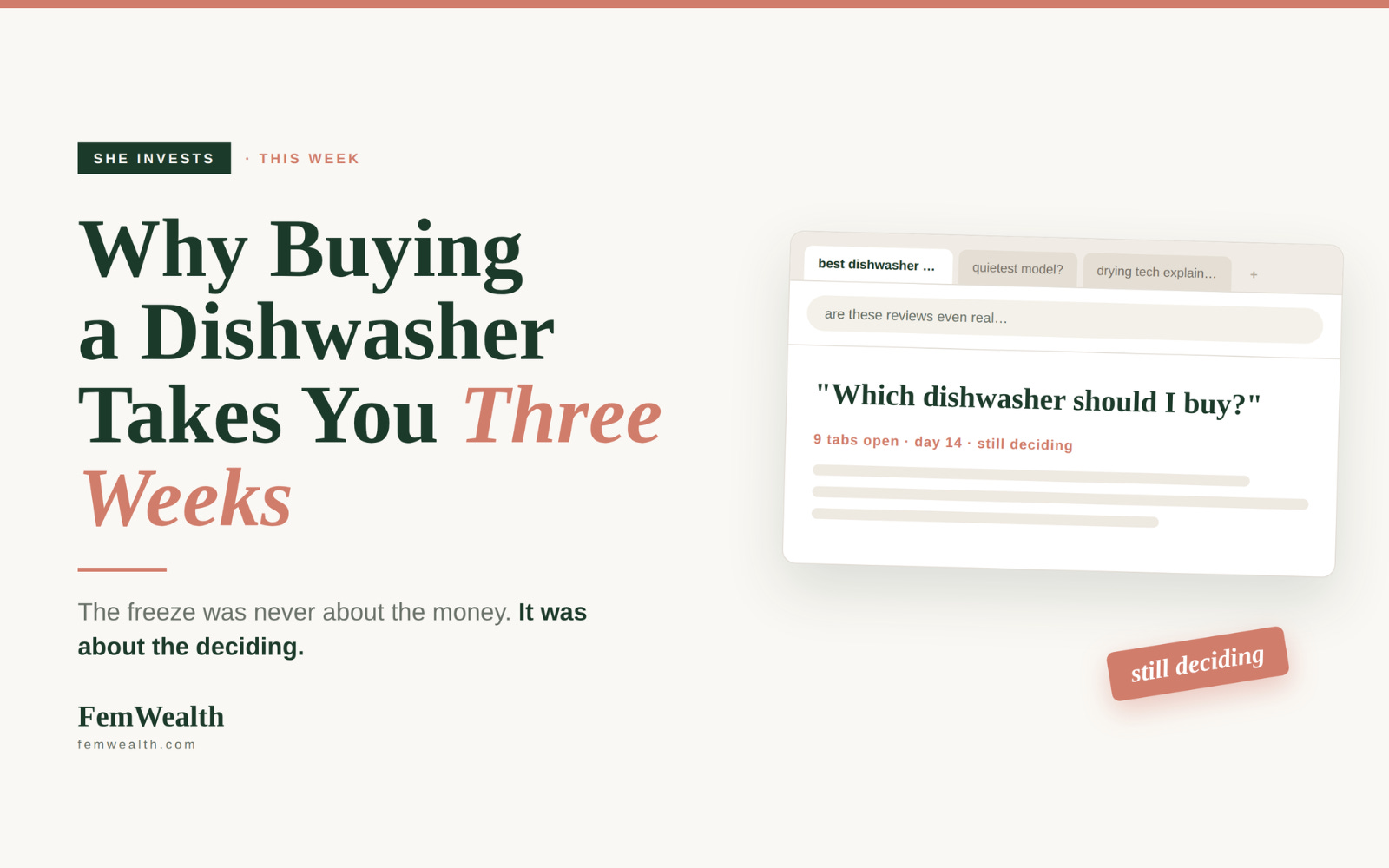
Why Buying a Dishwasher Takes You Three Weeks
The same freeze that costs you three weeks on an appliance is quietly costing you years on your money.

I promised you the numbers this week. How much each layer of the stack actually needs before you move up. That is coming next Thursday, I have not forgotten.
But while I was writing it, I noticed something I want to talk about first. Because it is the reason the numbers issue is even necessary. Here is the thing I noticed.
Last month I needed to buy a dishwasher. A dishwasher. Not a house. Not a pension. A machine that washes plates.
It took me three weeks.
I read reviews. I made a comparison table. I watched a video of a man in a warehouse explaining drying technology. I had nine tabs open. I asked three people. I came back to it every evening and got a little further and decided nothing.
And one of those evenings, mid-spiral, I realized I had done this exact thing before.
The last time I felt this way, I was not buying a dishwasher. I was trying to choose an index fund.
Same nine tabs. Same comparison table. Same “let me just check one more thing.” Same weeks passing with nothing decided.
That is when it clicked. The freeze was never about the money. It was about the deciding.
The freeze is not a knowledge problem
We tell ourselves the freeze is because we do not know enough yet. One more review, one more article, one more opinion, and then we will be ready to choose.
But you were ready three tabs ago.
The extra research is not getting you closer to a decision. It is helping you avoid making one.
Because here is what is actually happening. You are treating a small, fixable choice like it is huge and permanent. You are trying to make the perfect decision, when the decision does not need to be perfect. It just needs to be made.
A dishwasher is not forever. A fund is not forever. You can return the appliance. You can switch the fund next year. Almost nothing in your financial life is the irreversible, one-shot, get-it-exactly-right decision your brain is treating it as. The freeze comes from forgetting that.
The fix is fewer decisions, not better ones
Most advice tells you to make better decisions. Research more. Think harder. Be more rigorous.
That is exactly the advice that keeps you frozen.
The women who are not paralyzed by this are not smarter or more confident. They have just quietly removed most of the decisions. They decided once, set a rule, and stopped re-deciding every single time.
Three ways to do it.
Set a good-enough line, on purpose. Before you start researching anything, decide what “good enough” looks like. For the dishwasher, mine was: under $800, decent reviews, fits the gap, available this week. The first one that cleared all four, I bought. Done. The goal is not the best dishwasher in the world. It is a dishwasher, in your kitchen, this week.
Put a timer on the research. Give the decision a deadline that matches its size. A small choice gets an evening, not a fortnight. When the time is up, you choose from what you have. More time was not going to produce a better answer. It was just going to produce more tabs.
And the big one. Automate the money decisions so they stop being decisions at all. Should I invest this month? You already decided. The transfer happens on payday whether you feel like it or not. How much to my emergency fund? Already a standing order. You do not wake up and re-litigate it every month. You decided once, and then you let the rule carry it.
That last one is the whole game. The decisions that freeze you most are usually the ones you are making over and over, from scratch, every time. Make them once. Build the rule. Then never spend that energy again.
Why this matters more than it sounds
Every decision you make from scratch costs you something. Not just time. Attention. Willpower. The small dread that builds up around the thing you keep not doing.
And money decisions are the ones we most often leave un-systemised, so they are the ones quietly draining us all the time. The investing you keep meaning to start. The account you keep meaning to open. The fund you have had in a tab for a month.
You do not need to get better at making those decisions. You need to make them once and never again.
The more I think about it, the more I realise this is what we're building at FemWealth. A system that turns the money decisions you keep re-making into ones you set once and forget. So your energy goes to your life, not to your ninth browser tab.
If that is the version of money management you want, the app is almost here. You can join the waitlist at https://femwealth.com/waitlist/
Next week, as promised, the numbers. How full each layer needs to be before you move up.
And next month, the other half of this. Because some decisions genuinely are big and irreversible, and those deserve more than an evening and a timer. How to make the ones that actually matter, when you are the only one making them. More on that soon.
Until then.
Parvati, FemWealth
If this sounded a little too familiar, the next one will too. Come find out Thursday.
If the freeze sounds familiar, you are not alone, and it has a cost. I put a number on exactly what waiting costs you here: The Cost of Waiting Is the Most Expensive Thing You'll Never See
New to She Invests? Start here — five questions that point you to the right issue for where you are right now.
Or browse every issue by topic.