

You Are Allowed to Want This
The worthiness story most women carry about money - where it came from, what it costs, and why you're allowed to put it down.

What would you do with $1 million?
Take a moment. Really answer it.
Not the sensible answer. The real one. The one that includes the thing you’ve never said out loud because it felt like too much to want. The trip. The house. The freedom to say no to work that diminishes you. The ability to never check your bank balance before saying yes to something that matters.
Now notice what happened when you pictured it.
For most women, there’s a fraction of a second, sometimes less - before a quiet voice arrives.
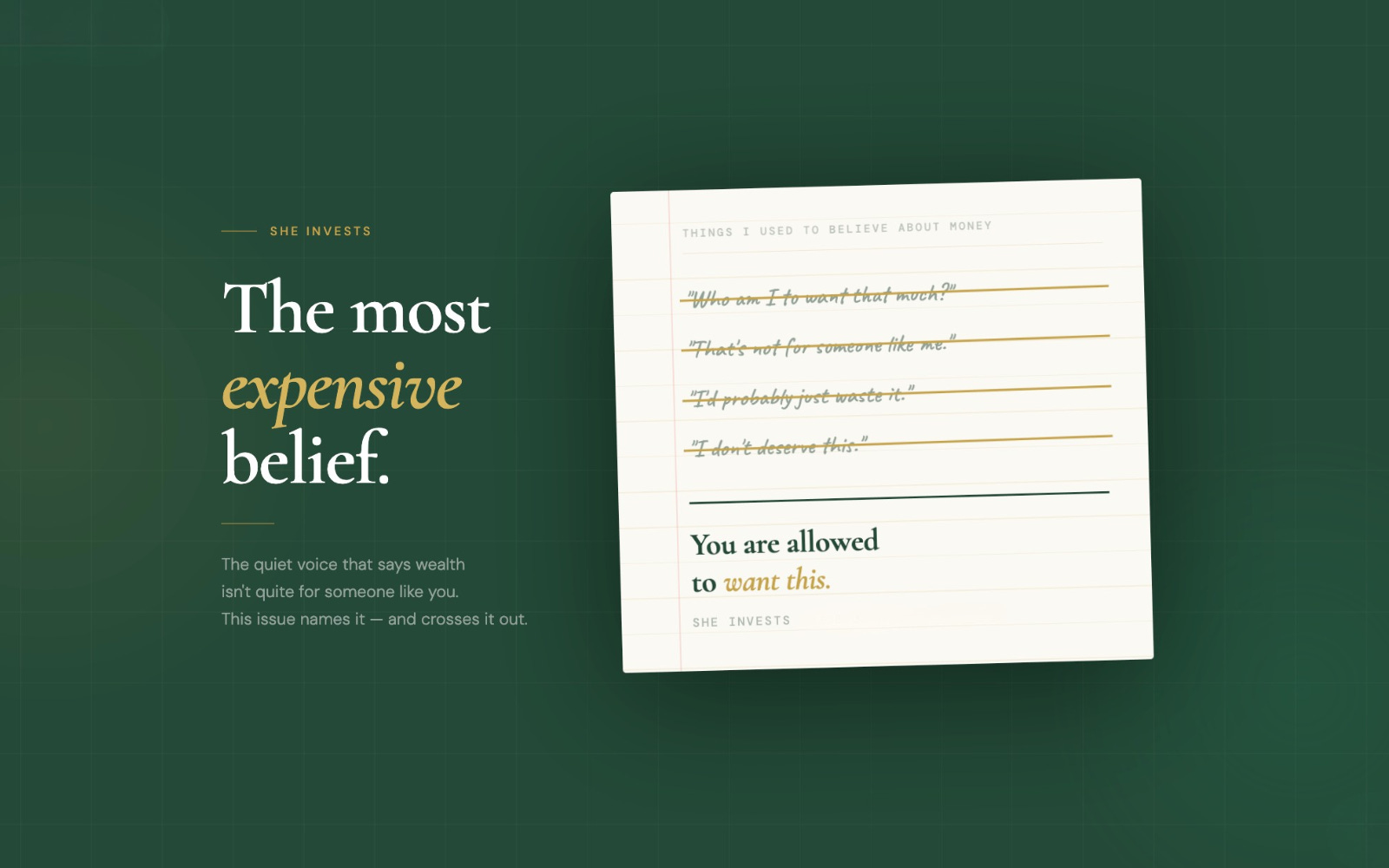
Who am I to want that much? That’s not really for someone like me. I’d probably just waste it. I don’t deserve that kind of money.
If you heard any version of that voice, this issue is for you.
Because that voice is not wisdom. It’s not humility. It’s not financial realism.
It’s a worthiness story. And it’s the most expensive belief most women carry.
What the Worthiness Story Actually Is
The worthiness story is the belief that is rarely examined, almost never named - that significant wealth is for a certain kind of person, and the quiet, persistent suspicion that you are not quite that person.
It shows up differently for different women.
For some it’s the feeling that wanting more money is greedy - that there’s something slightly unseemly about a woman who openly pursues wealth.
For others it’s a deeper, more private voice: that they haven’t earned it, that they got lucky, that if people knew the real story they’d understand why she doesn’t quite deserve what she has.
For others still it’s a practical disguise - I just don’t understand investing. That sounds like a knowledge gap but is actually a permission gap. The knowledge is available. The permission to use it feels like something she hasn’t been granted.
All three are the same belief in different clothes.
And all three have the same effect: they keep women on the sidelines of their own financial lives.
Where It Comes From
The worthiness story didn’t arrive from nowhere.
For most of recorded history, women were legally prohibited from financial life. We couldn’t own property independently, open bank accounts, sign contracts, or access credit without a male guarantor. In the United Kingdom, women couldn’t get a mortgage in their own name until 1975. In the United States, the Equal Credit Opportunity Act - the law that prohibited banks from discriminating against women in lending was only passed in 1974.
1974
That’s not history. That’s within the lifetime of many women reading this.
The message delivered explicitly for centuries and implicitly ever since was that money was not a woman’s domain. That financial decisions were better left to someone else. That ambition of the financial kind was unbecoming.
That message doesn’t disappear in fifty years. It becomes the water we swim in. It becomes the voice that arrives in the fraction of a second after you imagine $1 million and whispers who are you to want that?
The worthiness story isn’t a personal failing. It’s a cultural inheritance.
Understanding that is the first step to not letting it run your financial life.
Enjoying She Invests? Every Thursday I break down one investing concept, one framework, one action - written specifically for women building wealth on their own terms. Free to read, free to subscribe.
The Cost of the Story
The worthiness story has a price tag. Several, actually.
It keeps women from negotiating. Every salary left on the table, every rate accepted without question, every promotion not pursued - these are worthiness decisions dressed up as professional ones. The woman who doesn’t negotiate because she doesn’t want to seem greedy is letting a worthiness story make a financial decision.
It keeps women in cash. The money sitting in a low-interest savings account while inflation quietly erodes it is often not there because of a lack of knowledge. It’s there because investing feels like a declaration - I believe my future is worth investing in and that declaration requires a level of self-worth that the story doesn’t always permit.
It keeps women small in their goals. Goal-based investing only works if the goals are real. A woman running a worthiness story doesn’t set goals for the life she actually wants ; she sets goals for the life she thinks she’s allowed to want. Those are different lives. And different portfolios.
It keeps women waiting. The cost of waiting is enormous - we covered that in full two weeks ago. But we didn't name the most common reason women wait. It isn't the market. It isn't the knowledge gap. It's the quiet sense that now isn't the right time, that she isn't quite ready, that she should have more before she starts - all of which, underneath, are worthiness. I'll start when I deserve to.
The Myth of Earning It
One of the most persistent forms of the worthiness story is the belief that wealth must be earned in a very specific way - through sacrifice, through suffering, through a particular kind of relentless visible effort, before it is deserved.
This shows up as:
I’ll feel better about investing once I’ve paid off all my debt. I’ll start saving properly once I’m earning more. I’ll take my finances seriously once things settle down.
The logic sounds reasonable. It isn’t.
Wealth doesn’t wait for you to feel you’ve earned it sufficiently. Compound growth doesn’t operate on a moral schedule. The market doesn’t know whether you’ve suffered enough to deserve the returns.
The belief that you need to earn the right to build wealth - before you start building it is one of the most effective ways the worthiness story delays financial progress while appearing completely rational.
The truth is simpler and less comfortable: you are allowed to start now. Not when you’ve earned it. Now.
What Worthiness Actually Requires
Here’s what the worthiness story gets wrong.
It frames wealth as a reward. Something granted to those who have proven their value, demonstrated their discipline, earned their place.
But wealth isn’t a reward. It’s a tool.
And tools don’t care who uses them. They work for whoever picks them up.
The question is never whether you deserve wealth. The question is whether you’re willing to use the tools available to build it.
That reframe sounds simple. It isn’t. Decades of inherited messaging don’t dissolve in a paragraph. But it is the reframe and it’s the one that everything else rests on.
Because once you genuinely believe that wealth is a tool rather than a reward, the whole conversation changes.
You don’t negotiate because you deserve more. You negotiate because negotiating is how the tool works.
You don’t invest because you’ve earned the right. You invest because that’s how the tool grows.
You don’t wait until you feel worthy. You start now, because starting now is what the tool requires.
The Permission You’ve Been Waiting For
I want to say something directly.
You are allowed to want financial security.
You are allowed to want more than enough.
You are allowed to want wealth that gives you options - real options, not theoretical ones.
You are allowed to want money in your own name, under your own control, building toward your own goals.
Not because you’ve earned it.
Not because you’ve suffered enough.
Not because you’ve proven your virtue by wanting less than you could have.
Because you are a person. And people are allowed to build wealth.
The financial conversation women have been waiting for isn’t the one that teaches them about index funds or expense ratios or rebalancing schedules - though all of those matter.
It’s the one that starts here. With this. With the permission that nobody gave you and that you are allowed to give yourself.
She Invests lands every Thursday - free. One investing concept, one framework, one action. The financial conversation women have been owed for a long time.
Your Action Item This Week
Five things. But really just one.
1. Answer the $1 million question honestly. Write it down. The real answer - not the sensible one. What would you actually do? What does that answer tell you about what you're building toward?
2. Notice the voice. Over the next week, when you make a financial decision or avoid one - notice whether there's a worthiness story underneath it. Not to judge it. Just to see it.
3. Name one thing you’ve been waiting to “deserve.” Starting to invest. Negotiating your salary. Opening a Freedom Fund. What is the one financial move you’ve been putting off because it doesn’t feel quite earned yet?
4. Do that thing. Not next month. This week. Not because you’ve earned it. Because the tool works whether you feel worthy or not.
5. Forward this issue to one woman in your life. The worthiness conversation changes when it’s shared. The woman who reads this and recognises herself needs to know she isn’t alone in it.
The FemWealth Perspective
We’ve been building to this.
Why Women Are Better Investors Than Men told you women are better investors than men. The data is unambiguous. The edge is real.
The Cost of Waiting told you the cost of waiting is enormous. Every year of delay has a specific, calculable price tag.
The Four Money Scripts told you there’s a script running underneath - money avoidance, the most common script among women, the belief that wealth isn’t quite for someone like her.
This issue is the root of all three.
Because here’s the thing about the confidence gap that the financial industry never addresses: it isn’t a knowledge problem. The women who read this newsletter aren’t financially illiterate. They’re financially inhibited by a worthiness story so deeply embedded that it feels like personality rather than conditioning.
The confidence gap isn’t the absence of knowledge. It’s the presence of a story that says the knowledge doesn’t belong to you.
That story was never yours. It was handed to you by a culture that spent centuries making financial life inaccessible to women and then framed the resulting hesitancy as a female character flaw.
It is not a character flaw. It is a rational response to an irrational history.
And here is what FemWealth is built on: once you can see the story, you don’t have to keep living inside it.
Confidence → Goals → Investing.
Not the other way around. Confidence first - not because you need to feel ready, but because you need to believe you’re allowed. That belief is what this issue is about.
Next week we move from the root to the system. If the worthiness story is what holds women back from starting - next week is about what happens when you do start. The practical, unglamorous, entirely achievable architecture of a financial life built on your own terms.
The framework. The numbers. The plan.
See you Thursday.
Not subscribed yet?
She Invests lands every Thursday with one investing concept, one framework, one action you can take that week. No jargon. No condescension. Just the financial conversation women have been owed for a long time.
Read the full archive:
She Invests is published every Thursday by FemWealth — the financial operating system for women who invest on their own terms.
If someone forwarded this to you, welcome. You can subscribe here